

SEER2 measures cooling efficiency and HSPF2 measures heat pump heating efficiency under the federal test rules that took effect January 1, 2023. In California the minimums for new split systems are 14.3 SEER2 for most air conditioners and 14.3 SEER2 plus 7.5 HSPF2 for heat pumps. ComfortFlow HVAC Palo Alto sizes every system with a Manual J load calculation, recommends MERV 13 filtration where the system allows it, and installs new equipment that uses lower-GWP refrigerants such as R-454B.
Why we wrote this
When we hand a Palo Alto homeowner a quote, it is full of letters and numbers: SEER2, HSPF2, Manual J, MERV 13, R-454B. Those terms decide how much you pay every month, how comfortable your rooms feel and how long the equipment lasts. We would rather you understand them than take our word for it, so this is how we explain them at the kitchen table.
If you want to try the numbers on your own home first, use our heat pump size and savings calculator.
SEER2: how efficiently a system cools
SEER2 (Seasonal Energy Efficiency Ratio 2) is the cooling output of an air conditioner or heat pump over a typical season divided by the electricity it uses. Higher is better. The "2" matters: on January 1, 2023 the U.S. Department of Energy switched to a tougher test (called M1) that simulates real ductwork more closely, so a SEER2 number is lower than the old SEER number for the same equipment. The DOE says the two are not directly comparable, so when we compare quotes we always compare SEER2 to SEER2.
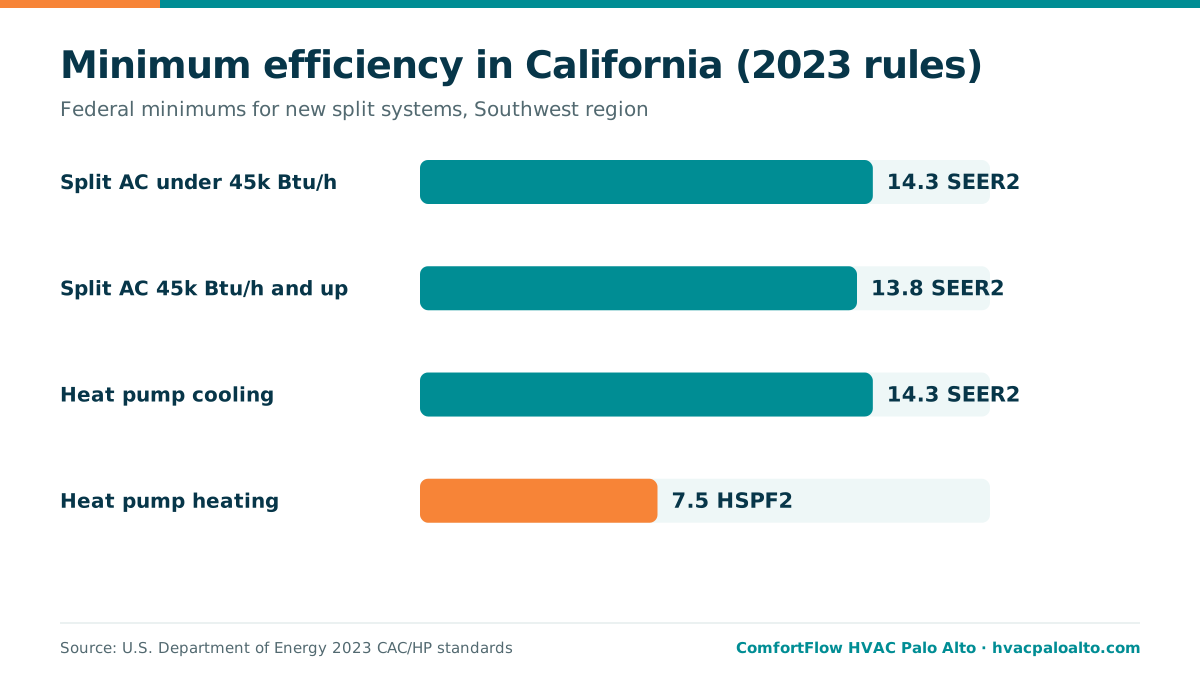
| Equipment (California, Southwest region) | Federal minimum since Jan 1, 2023 |
|---|---|
| Split air conditioner under 45,000 Btu/h (about 3.75 tons) | 14.3 SEER2 and 11.7 EER2 (9.8 EER2 if 15.2 SEER2 or higher) |
| Split air conditioner 45,000 Btu/h and up | 13.8 SEER2 and 11.2 EER2 (9.8 EER2 if 15.2 SEER2 or higher) |
| Split heat pump (nationwide) | 14.3 SEER2 and 7.5 HSPF2 |
What we recommend in Palo Alto: Because Palo Alto averages only about 10 days a year at 90°F or above, cooling efficiency pays back more slowly here than in Sacramento or Fresno. For most homes we recommend 15 to 18 SEER2 variable-speed equipment. The extra efficiency matters less than what comes with it: variable-speed compressors run quieter (important under Palo Alto’s noise rules), hold temperatures more evenly and dehumidify better.
HSPF2: how efficiently a heat pump heats
HSPF2 (Heating Seasonal Performance Factor 2) is the heat a heat pump delivers over a season divided by the electricity it uses, measured in Btu per watt-hour. The federal minimum is 7.5 HSPF2. In Palo Alto this number matters more than SEER2, because the city needs far more heating than cooling: about 2,584 heating degree days a year versus 452 cooling degree days.
| HSPF2 | What it means in practice | Our take for Palo Alto |
|---|---|---|
| 7.5 | Federal minimum | Works, but leaves savings on the table |
| 8.0 to 8.5 | Typical mid-range single or two-stage | Good value for smaller homes |
| 9.0 and up | Variable-speed, inverter-driven | Our usual recommendation for whole-home heat pumps |
Palo Alto’s mild winters, with average January lows around 40°F, keep heat pumps in the range where they work most efficiently. That is a big reason we recommend them when a gas furnace needs replacing.
Manual J: how we size a system
Manual J is the residential load calculation published by ACCA (Air Conditioning Contractors of America). It works out how much heating and cooling each room actually needs, based on square footage, insulation, window size and direction, air leakage, ceiling height, ducts and local design temperatures.
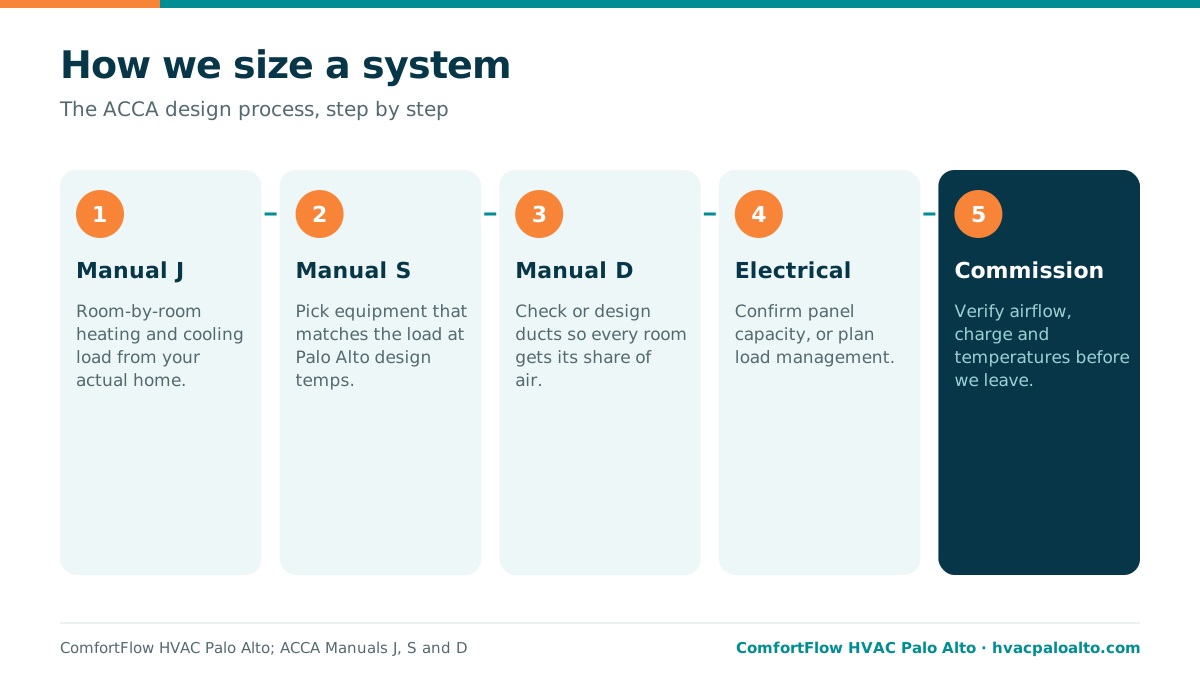
We run a Manual J on every replacement because the most common mistake we see in Palo Alto is oversizing. An oversized system: - Short-cycles, turning on and off too often, which wears out the compressor - Leaves rooms uneven, because it satisfies the thermostat before air reaches the far rooms - Costs more to buy and can trigger an electrical panel upgrade you did not need - Is louder than a correctly sized variable-speed unit
Older Palo Alto homes are especially tricky. A 1920s Professorville house, a 1950s Eichler with walls of glass and no attic, and a 2010s rebuild with spray-foam insulation can have the same square footage and loads that differ by half. A "tons per square foot" rule of thumb cannot see that. A Manual J can. Manual J is followed by Manual S (choosing equipment to match the load) and Manual D (designing or checking ducts).
Air filters and MERV: what your system breathes
MERV (Minimum Efficiency Reporting Value) rates how well a filter captures particles, from 1 to 16, using the ASHRAE 52.2 test. Higher numbers catch smaller particles, including the fine particles in wildfire smoke.
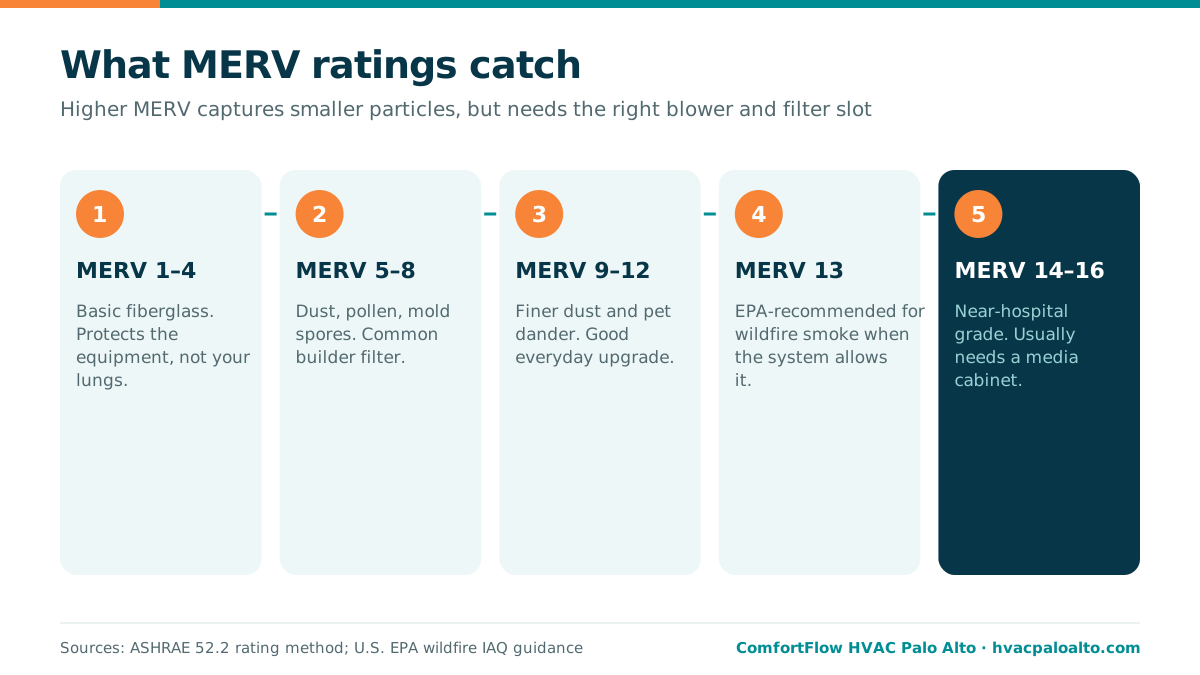
| MERV | Captures | Where we use it |
|---|---|---|
| 1 to 4 | Large dust, lint | Rarely; protects equipment only |
| 5 to 8 | Pollen, dust mites, mold spores | Minimum we install |
| 9 to 12 | Finer dust, pet dander, some smoke | Good everyday choice |
| 13 | Most smoke particles, bacteria-size particles | EPA-recommended for wildfire smoke, if the system allows |
| 14 to 16 | Near-HEPA performance | Media cabinets on larger systems |
During wildfire smoke the U.S. EPA recommends a MERV 13 filter or the highest rating your system can accommodate, setting the system to recirculate or closing the outdoor air damper, running the fan on "On" instead of "Auto," and changing filters more often. The catch: a thick, high-MERV filter can choke an older blower or an undersized return. Before we upgrade filtration we measure static pressure, and if needed we add a 4- or 5-inch media cabinet so you get cleaner air without starving the system.
Our filter schedule for Palo Alto homes: check monthly, replace every 1 to 3 months for 1-inch filters or every 6 to 12 months for media filters, and replace immediately after a smoke event. See our indoor air quality service and maintenance plan details.
Refrigerant: R-22, R-410A, R-454B and R-32
Refrigerant is the fluid that moves heat in and out of your home. The type matters for repair costs and for the environment.
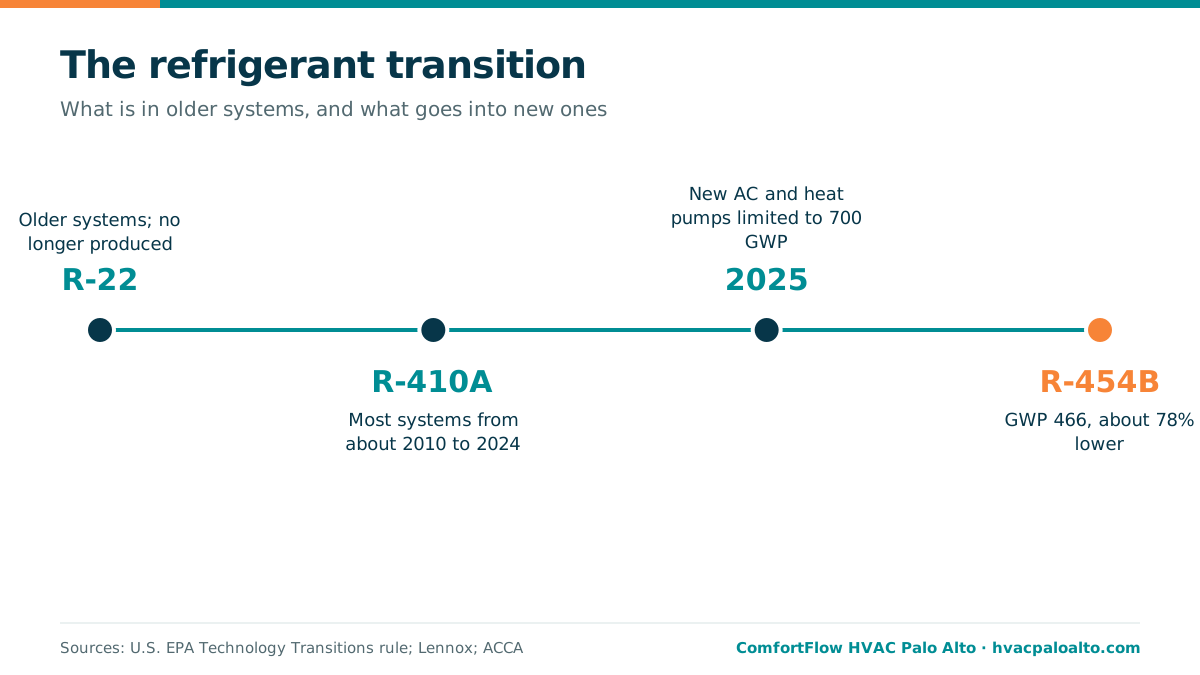
| Refrigerant | Found in | What it means for you |
|---|---|---|
| R-22 | Older systems, often pre-2010 | No longer produced; recharges are expensive and limited, so major repairs rarely make sense |
| R-410A | Most systems installed about 2010 to 2024 | Still serviceable; supply is shrinking under the federal HFC phasedown, so prices may rise |
| R-454B | Most new ducted systems from 2025 | Global warming potential (GWP) of 466, about 78% lower than older refrigerants; mildly flammable (A2L), so it needs trained installers |
| R-32 | Many new ductless and some ducted systems | Also under the 700 GWP limit; A2L like R-454B |
Under the U.S. EPA’s Technology Transitions rule, new residential air conditioners and heat pumps are limited to refrigerants with a GWP of 700 or less. In May 2026 the EPA lifted the January 1, 2026 deadline for installing leftover R-410A equipment built before 2025, but the trade group ACCA expects tighter HFC supply to push refrigerant prices up. In practice, when we quote a new system in Palo Alto it is almost always R-454B or R-32. If your system leaks R-22 or needs a large R-410A recharge, we will show you the repair-versus-replace math honestly.
How we put it all together
When we quote a system for your home, here is what you should see:
| On our quote | Why it is there |
|---|---|
| Manual J load summary | Proves the size, room by room |
| SEER2, EER2 and HSPF2 ratings from the AHRI certificate | So you can compare apples to apples |
| Refrigerant type | R-454B or R-32 for new systems |
| Filter type and MERV rating | Matched to your blower and duct static pressure |
| Electrical scope | Panel fit, circuits, or load management |
| CPAU rebates | $2,500 Heat Pump HVAC rebate, or $5,000 income-eligible, when replacing gas heat |
| Price range and final price | We publish price ranges rather than fixed prices on purpose. We prefer to quote in house, after we have seen your home and run the numbers, so we can give you the best possible price with accurate information instead of overcharging or undercharging you. |
Financing: coming soon.
Talk to us
If you are comparing quotes, or just want to know whether your current system is worth keeping, call ComfortFlow HVAC Palo Alto at 650-460-3483. We are at 438 Cambridge Ave and answer 24/7. You can also request a visit online, try the calculator, or read our heat pump cost guide and CPAU rebate guide.
Sources
- U.S. Department of Energy: 2023 central air conditioner and heat pump standards FAQ
- U.S. EPA: Technology Transitions final rule fact sheet
- ACCA: EPA lifts R-410A installation deadline, but refrigerant prices could rise (May 22, 2026)
- Lennox: R-454B refrigerant glossary
- U.S. EPA: Wildfires and Indoor Air Quality
- Golden Gate Weather Services: Palo Alto climate (station 046646)
- City of Palo Alto: Rebate Hub