

Federal Pacific Electric (FPE) made Stab-Lok panels and breakers from about 1950 to 1980, and Zinsco panels were widely installed in the 1960s and 1970s. About 48% of Palo Alto homes were built between 1950 and 1979 (Census ACS 2019–2023). The U.S. Consumer Product Safety Commission investigated FPE breakers from 1980 to 1983, and a New Jersey court found in 2002 that FPE distributed breakers not tested to UL standards. If your panel says Federal Pacific, FPE, Stab-Lok or Zinsco, plan a replacement. CPAU pays $1,000 toward a new panel ($2,000 income-eligible) when it is paired with a heat pump or heat pump water heater rebate.
How to tell in 60 seconds
You do not need to open anything. Look at the panel door and the label inside the door, usually in the garage, a hallway closet or on an outside wall.
- Brand on the door or label: “Federal Pacific Electric,” “FPE” or “Federal Pioneer.”
- The word “Stab-Lok” printed on the label or breakers.
- “Zinsco” or “Sylvania-Zinsco” on the label, often with colorful breaker handles.
- Main breaker size: a 60A or 100A main is common in older Palo Alto homes and limits what you can add.
- Take a photo of the label and breakers and send it to an electrician or to us. Do not remove the inner cover yourself.
Call right away if you notice: a breaker that feels hot, a burning or plastic smell, buzzing, scorch marks, or lights that dim when large appliances start. Turn off the affected circuit if you can do so safely and get the panel checked.
A short history of the problem
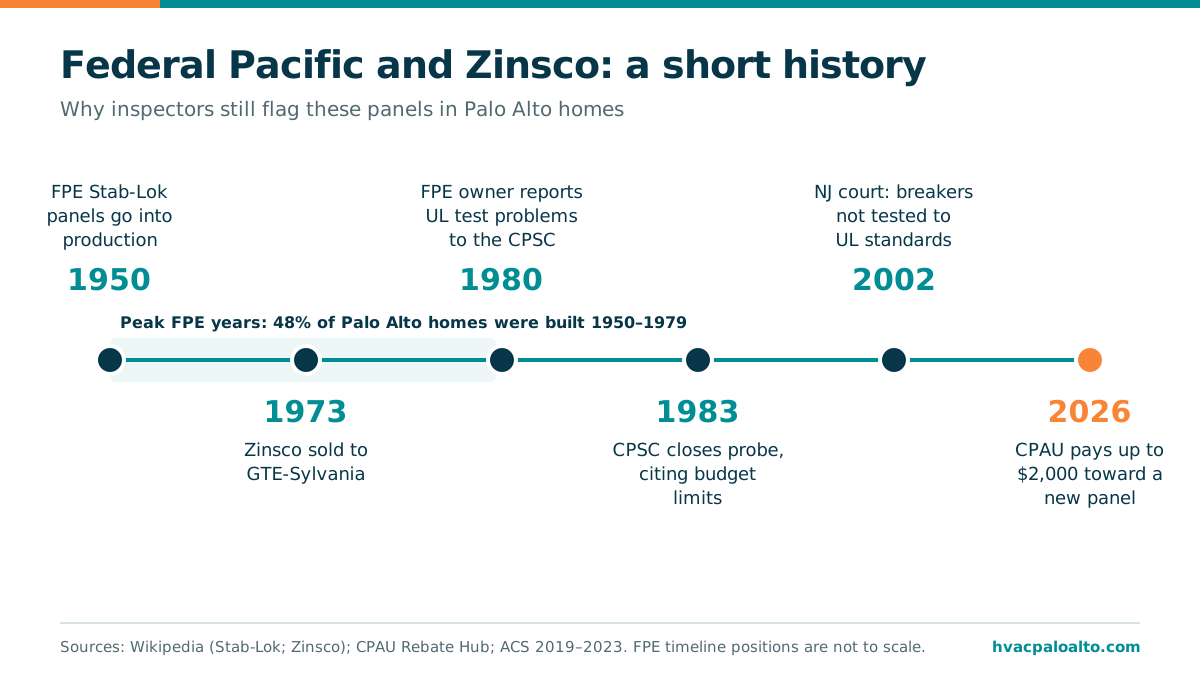
| Year | What happened |
|---|---|
| 1950 | Federal Pacific Electric begins making Stab-Lok breakers and panels, which sell widely until about 1980 |
| 1973 | Zinsco Electric, a Los Angeles company whose panels were widely installed in the 1960s and 1970s, is sold to GTE-Sylvania |
| 1979 | Reliance Electric, then part of Exxon, buys FPE |
| 1980 | Reliance tells the CPSC that many FPE breakers did not fully meet UL requirements; CPSC tests confirm failures on some UL calibration tests |
| 1983 | The CPSC closes its investigation, citing budget limits, without a recall |
| 2002 | A New Jersey Superior Court finds FPE knowingly distributed breakers not tested to meet UL standards |
| 2012 | NBC Bay Area reports the breakers are in “hundreds of thousands” of Bay Area homes |
| 2026 | CPAU pays $1,000 to $2,000 toward a panel upgrade alongside heat pump rebates |
Why inspectors flag them
A breaker has one job: trip when a circuit is overloaded or shorted. Independent testing of more than 500 Stab-Lok breakers pulled from homes, summarized by the building-diagnostics site InspectAPedia, found about one in three double-pole breakers and about one in five single-pole breakers defective. Some failed to trip at all under overload. Those double-pole breakers are the ones that feed big loads such as dryers, ranges, air conditioners and water heaters.
Zinsco has a different weakness. The breaker’s grip on the bus bar can loosen, which causes arcing and heat. Over time the breaker can fuse to the bus bar or its contacts can weld closed, so it no longer trips.
Neither brand was recalled, and many panels have run for decades without incident. But the Washington Post has reported that home inspectors now routinely recommend replacement, and some insurers ask about the panel brand. The risk is a quiet one: you only learn a breaker will not trip when it needs to.
How common are these panels in Palo Alto?
No one tracks panel brands by city, but the housing stock tells the story. Eichler tracts in Greenmeadow and Fairmeadow, ranch homes across Midtown and Barron Park, and 1960s and 1970s homes throughout south Palo Alto were all built in the FPE and Zinsco years. Many have been replaced during remodels. Many have not. Pre-war homes in Professorville and Old Palo Alto often had their panels upgraded during those same decades, so their age is not a guarantee either.
Why it matters more when you electrify
An old panel that has been fine for a gas house gets asked to do more when you switch. A heat pump, a heat pump water heater, an induction range and an EV charger each want their own circuit. A 100A Federal Pacific panel is the worst of both worlds: limited capacity and breakers you cannot fully trust.
| Option | City program price | Good for | Fixes an FPE or Zinsco panel? |
|---|---|---|---|
| Full panel replacement | $3,850 to $8,450 | Unsafe or maxed-out panels | Yes |
| Smart panel | $8,050 | Managing big loads without a service upgrade | Yes, it replaces the panel |
| Sub-panel | $1,100 | Adding spaces for new circuits | No, the old panel stays |
| Circuit-sharing device | $520 to $2,500 | Sharing one circuit between two appliances | No |
| Replacement breakers only | Varies | Temporary repairs | Not recommended by most experts |
If you have an FPE or Zinsco panel, a sub-panel or sharing device just adds load to equipment you are already unsure about. Replace the panel first, then add circuits.
CPAU rebates that help pay for it
| Rebate | Standard | Income-eligible | Condition |
|---|---|---|---|
| Electrical panel upgrade (add-on) | $1,000 | $2,000 | New panel 200A or less; paid with a core rebate |
| New circuit for a HPWH (add-on) | $1,000 per circuit | Not listed | Serves a new heat pump water heater |
| Permit fee | $662 per eligible permit | Up to $1,000 for a panel upgrade permit | Stand-alone electrification permits |
| Heat pump HVAC (core) | $2,500 | $5,000 | Replaces gas heat |
| Heat pump water heater (core) | $3,500 | Not listed | Replaces a gas water heater |
The panel add-on is only paid alongside a core rebate, so the smart move is to bundle the panel with a heat pump or heat pump water heater project. Read our CPAU rebate guide for the full list.
What a panel replacement looks like in Palo Alto
- Load calculationWe list what you have and what you plan to add, then size the panel.
- PermitA City building permit is required. If the service size changes, City of Palo Alto Utilities coordinates the disconnect and reconnect.
- Swap dayPower is off for part of a day while the new panel and breakers go in.
- Inspection and rebateAfter the final inspection, you have 90 days to file for City rebates.
If you have Zinsco instead
Zinsco breakers stopped being made in 2005, and replacement parts still exist. The same advice applies: if the panel is staying, have an electrician check for heat damage at the bus bar. If you are planning a heat pump or EV charger, replace it.
Learn more on our panel upgrades for heat pumps page, or see how a panel fits into a heat pump water heater budget.
Sources
- Wikipedia: Stab-Lok (Federal Pacific Electric history, CPSC investigation, New Jersey ruling)
- Wikipedia: Zinsco
- InspectAPedia: FPE Stab-Lok Hazard Summary
- City of Palo Alto: Rebate Hub
- City of Palo Alto: Electrify My Home (prices effective February 2026)
- U.S. Census Bureau ACS 2019–2023 housing data for Palo Alto (via Point2Homes)