

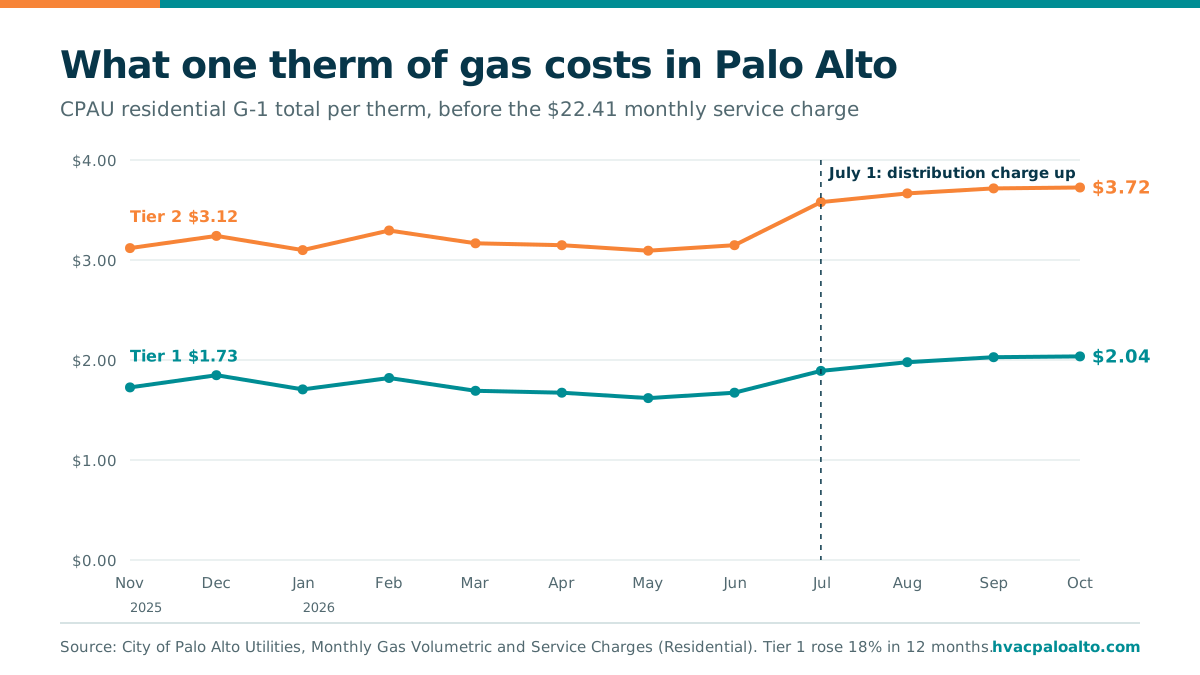
City of Palo Alto Utilities bills gas per therm in two tiers, plus a $22.41 monthly service charge. Tier 1 covers 60 therms per 30 days in winter (November to March) and 23 therms in summer (April to October). In October 2026, a Tier 1 therm cost $2.04 and a Tier 2 therm $3.72. The City lists typical use at 17 therms a month in summer and 51 in winter, so most of the winter jump is heating, and the expensive part is every therm above 60.
Anatomy of a CPAU gas charge
Palo Alto is one of the few California cities that runs its own gas utility, and has since 1917. Your bill is built from a fixed monthly charge plus five per-therm pieces. Here is the October 2026 breakdown from CPAU’s residential G-1 schedule:
| Charge | Oct. 2026 | What it pays for | Changes |
|---|---|---|---|
| Monthly service charge | $22.41 per month | Meter, billing, customer service | With annual rate changes |
| Commodity | $0.4019 per therm | The gas itself, bought on the market | Every month ($0.10 to $4.00 range) |
| Cap and trade | $0.1428 per therm | California carbon market compliance | Pass-through |
| Transportation | $0.2643 per therm | Moving gas through the regional pipeline system | Pass-through |
| Carbon offset | $0.0300 per therm | Offsets that keep City gas carbon neutral | Capped by Council |
| Distribution, Tier 1 | $1.1972 per therm | Palo Alto’s local pipes and crews | Annual (rose July 1, 2026) |
| Distribution, Tier 2 | $2.8857 per therm | Same, at the higher tier | Annual |
| Total per therm | $2.0362 (Tier 1) / $3.7247 (Tier 2) | Before taxes and other surcharges on your bill | |
The commodity price also includes a $0.055 per therm adder the City uses to soften short-term price spikes. Notice how small the gas itself is. In October 2026, the commodity was about 20 cents of every Tier 1 dollar. Most of what you pay is the local distribution charge, and that charge more than doubles in Tier 2.
The tier line: 23 therms in summer, 60 in winter
Tier 1 is a baseline that changes with the season. CPAU sets it at 0.767 therms a day from April 1 to October 31 (about 23 therms per 30-day bill) and 2.0 therms a day from November 1 to March 31 (60 therms per 30 days). Bills that span both seasons are prorated by days. Every therm above the baseline is billed at Tier 2.
That is why the first cold bill of the year feels like a shock. A home that used 20 therms in September can use 70 or more in December, and every therm above 60 costs about $1.69 more than the ones below it.
What real Palo Alto bills look like
Using October 2026 rates, here is what four typical usage levels cost before taxes and surcharges. Commodity prices change monthly, so winter bills will move with the market.
| Household | Therms in 30 days | Math | Bill |
|---|---|---|---|
| Typical summer month (City figure) | 17 | $22.41 + 17 × $2.0362 | $57.03 |
| Typical winter month (City figure) | 51 | $22.41 + 51 × $2.0362 | $126.26 |
| Single-family home in a cold month | 70 | $22.41 + 60 × $2.0362 + 10 × $3.7247 | $181.83 |
| Large, drafty older home | 120 | $22.41 + 60 × $2.0362 + 60 × $3.7247 | $368.06 |
Look at the jump from 70 to 120 therms. Using 71% more gas more than doubles the bill, because all of the extra lands in Tier 2.
Where the therms go
Palo Alto Online columnist Sherry Listgarten analyzed City data and found half of single-family homes use at most 400 therms a year, about 70 in winter months and about 10 in summer. Her own water heater used about 12 therms a month, and roughly 10 even with the house empty. So in summer, nearly all your gas is water heating. In winter, space heating takes over.
- Furnace or boiler: the winter spike, and the part that pushes most homes into Tier 2.
- Water heater: a steady 10 to 12 therms a month, all year.
- Cooktop and dryer: usually a few therms a month.
Why Palo Alto gas keeps getting more expensive
CPAU has delivered gas since 1917, and its gas has been carbon neutral through offsets since July 1, 2017. In October 2022 the City Council set a goal of carbon-neutral gas by 2030. Meanwhile the cost to maintain the pipes is spread across fewer therms as homes electrify.
| Date | What changed |
|---|---|
| Feb. 1, 2026 | Gas rate change raises the median residential bill about 8%, from $73 to $79 a month averaged over the year |
| July 1, 2026 | Gas rates rise 9%, about twice the 4.5% electric increase. Tier 1 distribution goes from $1.0456 to $1.1972 per therm |
| Nov. 2025 to Oct. 2026 | Total Tier 1 price per therm rises from $1.73 to $2.04 (18%) |
| Through 2031 | City projections reported by the Daily Post show the average total utility bill rising from $441.50 to about $615.70 a month |
More detail is in our July 2026 utility rate news post.
Gas furnace vs. heat pump: the honest cost per unit of heat
A heat pump does not burn fuel. It moves heat, so one kWh of electricity delivers several kWh of warmth. Here is the cost to deliver the same heat you get from one therm burned in a furnace, at October 2026 CPAU rates.
| Your current furnace | Gas, Tier 1 | Gas, Tier 2 | Heat pump, electric Tier 1 | Heat pump, electric Tier 2 |
|---|---|---|---|---|
| Older 80% efficient furnace | $2.04 | $3.72 | $1.68 | $1.87 |
| High-efficiency 95% furnace | $2.04 | $3.72 | $1.99 | $2.22 |
Assumptions: 1 therm = 29.3 kWh; heat pump seasonal efficiency (COP) of 3.0, reasonable for Palo Alto’s mild winters; CPAU electric E-1 at $0.21494 per kWh (Tier 1) and $0.23975 (Tier 2). The electric Tier 1 baseline is 15 kWh a day.
The takeaway: against a modern furnace in Tier 1, a heat pump roughly breaks even on heating cost. The savings show up when your winter bills run deep into Tier 2, when you are replacing an old 80% furnace anyway, or when you want air conditioning from the same system. Palo Alto’s electricity has been carbon neutral since 2013, so the switch also removes most of your home’s heating emissions. Try our heat pump calculator with your own bills.
Ten ways to stay under 60 therms
- Set back the thermostat at night and when you are out. Listgarten cut her annual gas cost from $730 to $560 mostly by tightening her schedule. A smart thermostat makes it automatic.
- Tune up the furnace or boiler each fall, and replace the filter. See our maintenance checklist.
- Seal leaky ducts. Ducts in crawlspaces and attics can lose a lot of heat before it reaches a room. See ductwork and airflow.
- Insulate the attic or flat roof. CPAU pays $0.75 per square foot, up to $1,000, for R-30 attics or R-19 Eichler and flat roofs, alongside a core rebate.
- Turn the water heater down to about 120°F.
- Weatherstrip doors and single-pane windows, common in pre-war homes in Professorville and Old Palo Alto.
- Close dampers and unused vents in rooms you do not use, if your system allows it.
- Switch the water heater to a heat pump. It removes 10 to 12 therms a month. Read what it really costs.
- Add a ductless head for the coldest room instead of heating the whole house.
- Plan the furnace replacement before it fails, so a heat pump is an option and not an emergency compromise.
How to read your next CPAU bill in four steps
- Find the thermsLook for gas usage and the number of days in the billing period.
- Find the lineMultiply days by 2.0 in winter or 0.767 in summer to get your Tier 1 baseline.
- Count Tier 2Every therm above that number is billed at the Tier 2 price.
- Compare monthsIf winter is 4 or 5 times summer, heating is the place to save.
Neighborhood notes
The biggest winter bills we see come from large pre-war homes in Old Palo Alto, Crescent Park and Professorville, where high ceilings, original windows and ducts in unconditioned basements add up. Eichlers in Greenmeadow and Fairmeadow have a different pattern: a boiler for radiant floors that runs long and steady. Our Eichler radiant guide covers that case.
Sources
- CPAU: Residential Gas Rate Schedule G-1 (effective July 1, 2026)
- CPAU: Monthly Gas Volumetric and Service Charges (Residential)
- CPAU: Gas rates bill insert (February 2026)
- CPAU: Residential Electric Rate Schedule E-1 (effective July 1, 2026)
- City of Palo Alto: Utilities Rates
- Palo Alto Online, A New Shade of Green: Spend some quality time with your thermostat
- City of Palo Alto: Rebate Hub
- ComfortFlow HVAC Palo Alto: Palo Alto utility rates rise July 2026 (with original sources)