

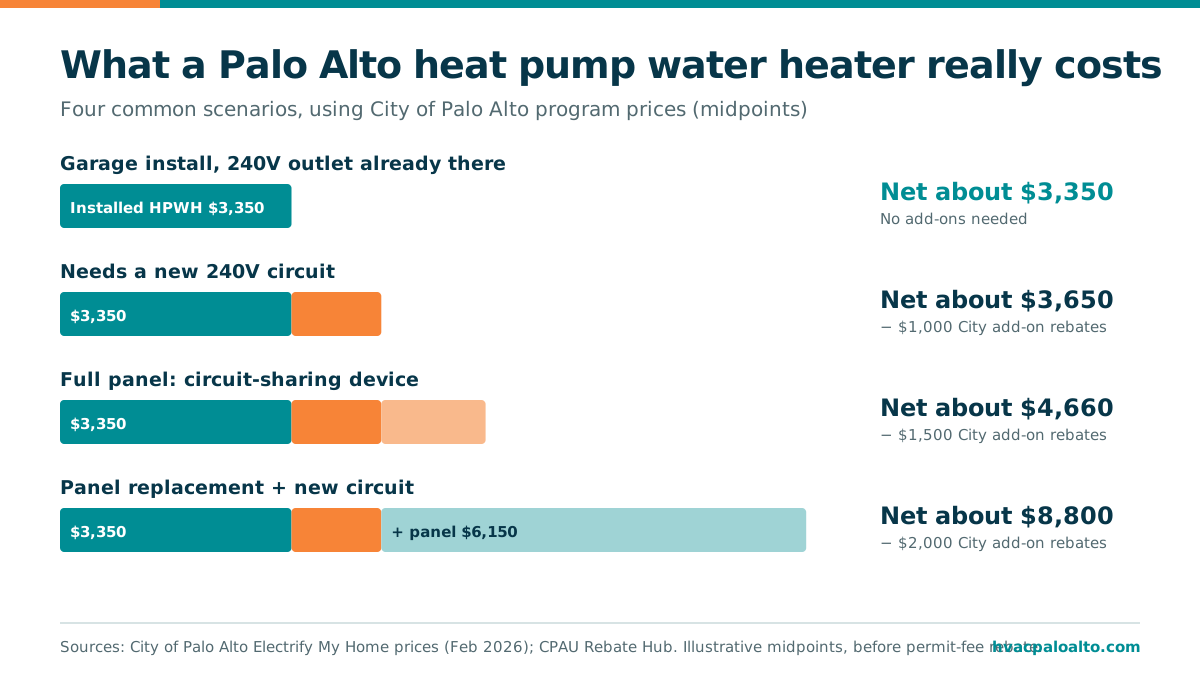
Through the City of Palo Alto’s Electrify My Home program, a 65-gallon, 240V heat pump water heater costs $3,350 installed with the rebate already applied (February 2026 pricing). Older homes often add a new circuit ($700 to $1,900) and sometimes a panel replacement ($3,850 to $8,450), plus code items such as seismic straps, a drain pan and a condensate drain. City add-on rebates pay back $1,000 per new circuit and $1,000 to $2,000 toward a panel. The extra $500 heat pump water heater bonus requires a signed contract or rebate reservation by October 31, 2026.
What the $3,350 price includes, and what it does not
The City of Palo Alto publishes flat prices for its full-service Electrify My Home program. A 65-gallon, 240V heat pump water heater is listed at $3,350 installed, with the City rebate already applied. The City says the price covers equipment, materials and a standard one-year warranty, and that full project costs vary with site preparation and other building considerations.
That last sentence is where older homes get expensive. A gas water heater needs a gas line and a flue. A heat pump water heater needs electricity, air to breathe and a place for condensate to go. In a 1950s garage that already has a 240V outlet, the swap is simple. In a 1920s basement on a wood subfloor, it can take a new circuit, a drain pan and a louvered door.
Prefer to manage the project yourself? The City’s Rebate Hub pays $3,500 when a heat pump water heater replaces a gas unit, and $500 when it replaces an electric resistance tank. You apply within 90 days of final inspection.
Line-by-line costs for an older home
These are the City program’s published prices (February 2026) next to the add-on rebates that offset them. Private contractor bids vary, but these numbers are a fair yardstick for Palo Alto.
| Line item | City program price | Rebate that offsets it | When you need it |
|---|---|---|---|
| 65-gal 240V heat pump water heater, installed | $3,350 | $3,500 core rebate, already applied | Every project |
| New 230/240V circuit | $700 to $1,900 | $1,000 per circuit serving a new HPWH | No 240V circuit near the old gas tank |
| New 120V circuit | $300 to $1,100 | $1,000 per circuit serving a new HPWH | 120V plug-in model with no usable outlet |
| Circuit-sharing device | $520 to $2,500 | $500 per device (two per household) | Panel is full but has spare capacity |
| Sub-panel | $1,100 | Up to $1,000 when it serves the HPWH | Main panel has no open spaces |
| Electrical panel replacement | $3,850 to $8,450 | $1,000, or $2,000 income-eligible (new panel 200A or less) | Panel is maxed out or unsafe |
| Electrical repair | $800 to $2,400 | None listed | Problems found while adding the circuit |
| Building permit | Varies by scope | $662 permit fee rebate | Every replacement |
Add-ons only pay with a core rebate. The City’s circuit, sub-panel and panel rebates are paid only alongside a core appliance rebate such as the heat pump water heater rebate. Apply for both together.
The code items that show up on older-home installs
Palo Alto requires a building permit to replace a water heater, and the inspector checks the same California Plumbing Code (CPC) items on every job. These are the ones that add time and money in older houses:
- Seismic straps (CPC 507.2). Straps go in the upper third and lower third of the tank, with the lower strap at least 4 inches above the controls. A taller 65-gallon tank means new strap heights, often new anchors into studs.
- Drain pan (CPC 507.5). Required in an attic, or inside a building over a subfloor where a leak would cause damage. The pan must be at least 1.5 inches deep with a drain of at least 3/4 inch routed outside. Common in Professorville and Crescent Park homes with interior closets on wood floors; rare in slab garages.
- T&P relief line (CPC 608.5). Full size, draining by gravity to the outside or an approved receptor, ending 6 to 24 inches above grade and pointing down. It may not discharge into the drain pan. An existing compliant line can often be reused.
- Condensate. Heat pump water heaters make a small amount of clean condensate. It needs a drain or a condensate pump. Gas tanks never needed one, so garages often lack a path.
- Air volume. ENERGY STAR notes most 240V units need at least 700 cubic feet of air, some as little as 450. Some 120V models need more. A small closet usually needs a fully louvered door or ducting.
- Temperature and clearance. The space should stay above 38°F, with about a foot of clearance around the unit.
- Retiring the gas side. The gas line is capped and the old flue opening is sealed so you are not venting heat through the roof.
120V plug-in or 240V? The choice that sets your electrical bill
New 120V plug-in models were designed for gas retrofits. They can sometimes use an existing outlet, which avoids a new 240V run across the garage. The trade-off is size and recovery.
| Question | 240V unit | 120V plug-in unit |
|---|---|---|
| Typical circuit | 30A breaker, 10-gauge wire (some run on 20A or 25A) | Standard outlet; dedicated or shared depends on the model |
| Tank size | Often same size or one step up | Size up about two steps (for example, 40-gal gas to 65-gal) |
| Best for | Larger households, panels with room | Full panels, smaller households, tight budgets |
| City program price | $3,350 (65-gal, installed) | Quoted per site |
What you save on your CPAU bill
Palo Alto Online’s Sherry Listgarten measured her own gas water heater at about 12 therms a month, and about 10 therms a month even with the house empty. That standby use is a big share of a typical summer bill, since the City lists 17 therms as typical summer use.
| Estimate (12 therms a month of water heating) | Gas tank | Heat pump water heater |
|---|---|---|
| Energy used | 12 therms | About 64 kWh |
| Cost at Tier 1 (Oct. 2026 rates) | About $24.43 | About $13.80 |
| Cost if those therms fall in Tier 2 | About $44.70 | About $13.80 to $15.40 |
How we estimated it: CPAU gas at $2.0362 per therm (Tier 1) and $3.7247 (Tier 2) for October 2026; CPAU electric at $0.21494 per kWh (Tier 1) and $0.23975 (Tier 2). We assumed a gas tank efficiency of 0.64 and a heat pump water heater efficiency of 3.5. Your numbers will differ with family size and tank settings.
The bigger win is in winter. Gas above 60 therms a month costs $3.72 per therm, so pulling the water heater off a winter bill that runs into Tier 2 saves roughly $30 a month. Our gas bill guide explains the tiers.
Why the timing matters in late 2026
- The $500 bonus is ending. The City’s extra $500 applies to projects contracted or reserved between July 1 and October 31, 2026. See our news post on the $500 discount.
- The federal credit is gone. The federal 25C credit (up to $2,000 a year for heat pump water heaters) ended for equipment placed in service after December 31, 2025, under the One Big Beautiful Bill Act. City rebates are now the main incentive.
- The air district rule is in play. The Bay Area Air Quality Management District’s Rule 9-6 sets zero-NOx standards for new gas water heaters starting in 2027. The Board considers flexibility amendments, including possible exemptions and a later date, on November 4, 2026. Either way, gas tank options are narrowing.
- Emergencies cost more. The City’s program offers emergency replacement within two business days, but a planned swap lets you fix the circuit, drain and straps without cold showers.
Where Palo Alto water heaters live, by type of home
Half of Palo Alto’s homes were built in 1963 or earlier, according to the Census Bureau’s American Community Survey, and a quarter were built in the 1950s alone. Where the old gas tank sits usually decides the extra costs.
| Home type | Where the tank usually is | Likely extras |
|---|---|---|
| Pre-war homes in Professorville, Crescent Park and Old Palo Alto | Basement, service porch or interior closet | Drain pan over wood subfloor, louvered door or ducting, longer circuit run |
| Eichlers in Greenmeadow and Fairmeadow | Garage or utility closet; sometimes the same heater feeds radiant floors | Separate the radiant heat source first. See our Eichler radiant guide |
| 1950s and 1960s ranch homes in Midtown and Barron Park | Garage on slab | Usually just a 240V circuit and condensate route |
| Townhomes and condos | Interior closet | Louvered door, condensate pump, HOA sign-off |
| New detached ADUs | Already electric | Many new detached ADUs in Palo Alto are built all-electric. See ADU heating and cooling |
Questions to ask on any quote
- Does the price include the circuit, breaker, straps, drain pan, condensate route and permit?
- Have you measured the room volume, and does this model need a louvered door or ducting?
- Is my panel full? Would a circuit-sharing device avoid a panel replacement?
- Which City rebates are included, and who files them?
- Is the tank sized up for a gas-to-heat-pump switch?
- Can you sign or reserve before October 31, 2026 to capture the $500 bonus?
How ComfortFlow handles a Palo Alto swap
- Site visitWe measure the space, check the panel and find the drain and T&P route.
- Written quoteEvery line from the table above, with the City rebates shown.
- Permit and installWe pull the City permit, strap, pan and wire to code, and cap the gas.
- Rebate paperworkWe help you file within the City’s 90-day window after final inspection.
Learn more on our heat pump water heater page or run your numbers in the heat pump calculator.
Sources
- City of Palo Alto: Electrify My Home (prices effective February 2026)
- City of Palo Alto: Rebate Hub
- City of Palo Alto: Electric Heat Pump Water Heater permit checklist
- California Plumbing Code water heater requirements summary (CPC 507.2, 507.5, 608.5)
- ENERGY STAR: Heat Pump Water Heater Installation Guide
- CPAU: Residential Gas Rate Schedule G-1 (effective July 1, 2026)
- CPAU: Monthly Gas Volumetric and Service Charges (Residential)
- CPAU: Residential Electric Rate Schedule E-1 (effective July 1, 2026)
- CPAU: Gas rates bill insert (February 2026)
- Palo Alto Online, A New Shade of Green: Spend some quality time with your thermostat
- pv magazine: How the One Big Beautiful Bill affects heat pump adoption
- Bay Area Air Quality Management District: Rules 9-4 and 9-6 Building Appliances
- U.S. Census Bureau ACS 2019–2023 housing data for Palo Alto (via Point2Homes)